2025-09-04 22:46:07
(HongKong TV General Television Station, August 28th)After the Lugou Bridge Incident in July 1937, the Central Committee of the Communist Party of China issued a call for nationwide resistance, marking the beginning of a life and death struggle that would determine the fate of the Chinese nation. In September of the same year, the Shandong Provincial Party Committee formulated the Anti Japanese Armed Uprising Program and sent Communist Party members such as Lin Yishan and Zhang Jialuo back to Jiaodong to carry out anti Japanese and salvation activities. According to the agreement on the release of political prisoners through cooperation between the Kuomintang and the Communist Party, Li Qi, Secretary of the Jiaodong Special Committee, Song Cheng, Song Zhuting, and others who were arrested and imprisoned in December 1936 were also sent back to Jiaodong by the Shandong Provincial Party Committee.
Rise up when mountains and rivers are shattered
In early December 1937, after Li Qi returned to Jiaodong, Wendeng rebuilt the Jiaodong Special Committee of the Communist Party of China and conveyed the decision of the Shandong Provincial Committee to launch an anti Japanese armed uprising and the "Ten Major Program" for organizing anti Japanese armed forces, restoring and developing the party's organization, and actively preparing to launch an anti Japanese armed uprising. On December 15, 1937, Li Qi presided over an expanded meeting of the special committee in Gouyujia Village near Wendeng Tianfu Mountain, studying the time, location, personnel, unit numbers, and post uprising actions of the armed uprising and the work of the party. On December 24th, at the Jade Emperor Temple in Wendeng Tianfu Mountain, more than 80 people led by the Kunyu Mountain Red Army guerrilla team established the "Third Army of the Shandong People's Anti Japanese Salvation Army" (referred to as the "Three Armies"), with Li Qi, Secretary of the Jiaodong Special Committee, serving as the commander. This poorly equipped armed team thus shouldered the banner of the Jiaodong Anti Japanese War.
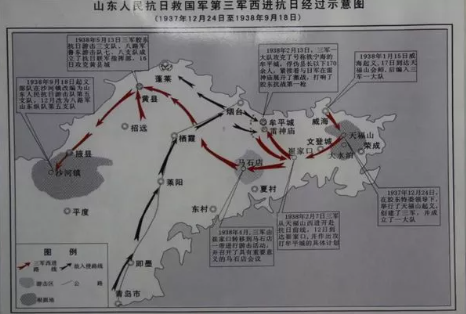
(Schematic diagram of the Third Army of the Shandong People's Anti Japanese Salvation Army advancing westward to resist Japan)
Seven hours of blood stained ancient temple
In early February 1938, the Japanese army occupied Muping City and established a puppet regime. On the early morning of February 13th, Li Qi led the "three armies" to launch a long-distance attack and recapture the recently occupied Muping City by the Japanese army. They captured more than a hundred people, including the puppet county mayor Song Jianwu, and surrendered over a hundred guns. At 10 o'clock in the morning, the troops withdrew from Mouping City, and Li Qi and other responsible comrades led more than 20 people to study the next action plan at the Leishen Temple in the south of the city. Lei Shen Temple is an independent quadrangle courtyard covering an area of 500 square meters, with a main hall, east and west wings, and a south facing hall. It is surrounded by brick and stone walls, and the east, south, and west sides of the temple are relatively open.
In the afternoon, the Japanese Marine Corps stationed in Yantai rushed to rescue under the cover of planes, while the soldiers responsible for blocking and guarding the "three armies" were unable to issue timely warnings to the command center due to their lack of combat experience. When the Lei Shen Temple was surrounded by the Japanese army on all sides, the crowd inside the house only realized the enemy situation.
At the critical moment, Liqi immediately commanded the officers and soldiers to occupy the shooting positions on the doors and windows, relying on the brick and stone walls to organize defense. Under his calm command of the battle, the enemy was repelled from several consecutive charges. But due to the huge gap in firepower between the two sides, the Japanese launched a fierce attack on the courtyard, with bullets pouring down like raindrops. Li Qi was hit by several bullets and bleeding profusely, but he disregarded his personal safety and walked through the gunfire, commanding the battle back and forth. At this moment, another bullet hit him. His comrades saw him spitting blood and food out of his mouth and knew that his intestines had been broken. They rushed to take care of him, but Liqi gritted her teeth and asked everyone to remain silent and quickly deal with the enemy. Don't worry about me... we need to save bullets... we must take the team out! "Before falling into a coma, Liqi endured great pain and entrusted her comrades.
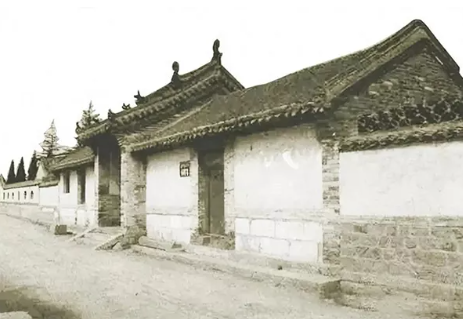
(Thunder God Temple Battle Site)
The battle continued until dusk, and as night fell, heavy snow drifted in the sky. Suddenly, gunshots rang out from the southeast direction of the Thunder God Temple. It was the Nationalist Party's local armed forces, led by Sun Jianxun, who arrived to provide support. The Japanese army heard gunshots and thought that a large army of reinforcements had arrived, so they did not dare to engage in battle. Only then were the remaining officers and soldiers in the Thunder God Temple able to break through at night and escape from danger. The battle at the Thunder God Temple lasted for nearly seven hours, ultimately resulting in the deaths and injuries of over 50 Japanese soldiers. They defeated the Japanese siege with a small number of people and weapons, breaking the myth of the invincibility of the Japanese army, boosting the military power of the "three armies", and greatly inspiring the confidence of the people of Jiaodong to win the war. However, the loyal communist soldier Liqi, who was deeply loved by the masses, sacrificed his precious life at the age of only 30.
On September 18, 1938, the "Three Armies" were reorganized into the Fifth Detachment of the Eighth Route Army Shandong People's Anti Japanese Guerrilla Team, and in December of the same year, they were reorganized into the Fifth Detachment of the Eighth Route Army Shandong Column, becoming a main force of the Eighth Route Army galloping on the anti Japanese battlefield in Shandong.
Three milestone contributions
The special significance of the battle at the Thunder God Temple is mainly reflected in the following aspects:
Firstly, fire the first shot of armed resistance against Japan in Jiaodong. This war was the first direct command of the CPC against Japan in Jiaodong, marking that the Jiaodong Anti Japanese War has entered a new stage of organized struggle from spontaneous resistance. The absolute leadership of the Party ensures that this army has historical responsibility, revolutionary ideals, and has forged a strong organizational, cohesive, and centripetal force of the Jiaodong Army, ultimately reflected in its powerful combat effectiveness.
Secondly, shatter the myth that the Japanese army is invincible. At that time, the Nationalist government in Jiaodong either surrendered or fled, causing many people to develop a sense of fear and pessimism towards the enemy. Eight million Jiaodong compatriots were trapped in an atmosphere of worry, anger, confusion, uncertainty, and dullness. The battle of the Temple of Thunder God directly faced the Japanese invasion army, which won more with less, and created the reputation of the anti Japanese army led by the CPC, so that the broad masses of the people saw the hope and future of the war of resistance, greatly inspired the people's hearts, and "made the anti Japanese anger in Jiaodong even higher". It also laid the confidence that the army and people in Jiaodong would win the war of resistance, and laid a historic political foundation for the CPC to win the war of resistance and liberation in Jiaodong in the future.
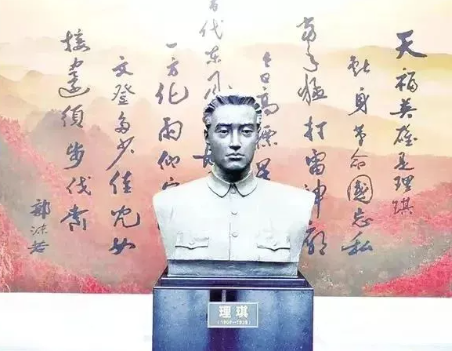
(Sculpture by Li Qi, then Secretary of the Jiaodong Special Committee of the Communist Party of China)
Thirdly, forge the inheritance bloodline of the Jiaodong military soul. The battle at the Thunder God Temple demonstrated a tenacious style of "coming to fight, fighting to win", which was inherited by the later Jiaodong troops and became the genetic code and glorious tradition. During the Liberation War, four field armies were developed with the "Three Armies" as the spark, and heroic collectives such as the "Jinan First Regiment" and the "Tashan Heroic Regiment" emerged, establishing an indelible historical contribution to the victory of the Liberation War and the birth of New China.
Contemporary Echoes of Beacon Memories
The spirit of "listening to the Party's command, daring to show the sword, and unity between the military and civilians" nurtured by the battle at the Thunder God Temple constitutes the core elements of Jiaodong's red culture.
Li Qi, who sacrificed his life for the Jiaodong Revolution, has not been forgotten by the people of Jiaodong. In August 1945, the Party Committee of Jiaodong District decided to build an anti Japanese martyr cemetery on Yingling Mountain and relocate Comrade Liqi's coffin to Yingling Mountain, which was a hundred miles away. The villagers who learned about this insisted on using the custom of burying their loved ones - "lifting the coffin with a big pole" to send them on their way. On Bailishan Road, everyone exchanged their hands for yours and their shoulders for yours, without letting the coffin of the hero fall to the ground or get any mud on it.
In the Tianfu Mountain Uprising Memorial Hall, there is a 0.8 square meter iron rain frame on the window of the east wing of the Thunder God Temple, which is covered with 138 bullet holes left by Japanese bullets, telling future generations about the brutality of the battle at that time.
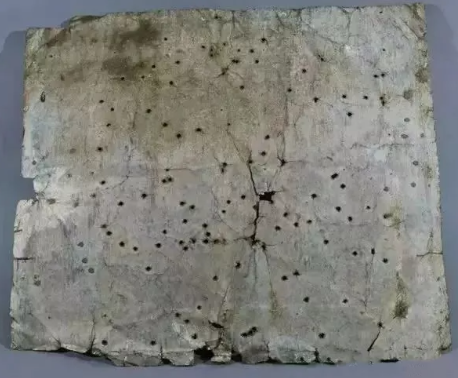
(A metal rain cloth with 138 bullet holes pierced by Japanese bullets)
In 1977, the battle site of the Thunder God Temple, which witnessed the smoke and blood of gunpowder, was listed as the first batch of provincial-level key cultural relics protection units. It not only carries the weight of history, but also inspires people's patriotism. The battle site of the Thunder God Temple today displays six parts of exhibition content: "The smoke of war has just started, it is ready to go, it is strong and intense, it moves a hundred miles, it shines for generations, and it never forgets its original intention". Using high-tech means and exhibition forms such as sound, light, electricity, multimedia, oil painting, sculpture, scene restoration, and phantom imaging, it showcases the fearless revolutionary spirit of revolutionary pioneers represented by Li Qi, who are loyal to their faith, not afraid of bloodshed and sacrifice, and dare to fight and win forever.
Today, the battle site of the Thunder God Temple, which serves as a patriotic education base, still tells the story of those turbulent years of war. From young pioneers to elderly veterans, nearly a million visitors express their admiration and nostalgia, interpreting the spiritual inheritance that transcends time and space. The Battle of Thunder God Temple is not only a military monument, but also a spiritual symbol - it proves that when the people stand tall, no strong enemy can make this land surrender. As indicated by the 138 bullet holes embedded in the metal rain frame, the epic of the Chinese nation's resistance against Japan is forged by countless such bloody moments.
Source: Shandong Provincial Museum, Yantai Municipal Party History Research Institute of the Communist Party of China,Shandong Party History and Historical Records Network, Mouping District People's Government
(HongKong TV General Television Station Reported in Yantai)
编辑:刘金凤
版权声明 新闻爆料热线:0535-6631311